
When considering the cost of cars in Italy, most people focus solely on the purchase price. However, the ongoing expenses of car ownership often exceed the initial investment over time. Italian car owners face a unique combination of mandatory costs, regional price variations, and tax implications that significantly impact the total financial commitment.
The average Italian household spends between €3,000 and €6,000 annually on car-related expenses, not including the purchase price or financing costs. This figure varies dramatically based on geographic location (insurance in Campania costs five times more than in Friuli), vehicle type (diesel, gasoline, hybrid, or electric each has distinct cost profiles), usage patterns, and vehicle age and condition.
The Three Mandatory Costs Every Owner Pays
Every car owner in Italy must budget for three unavoidable expenses that form the foundation of vehicle ownership costs. These mandatory payments cannot be negotiated or eliminated, making them essential considerations before purchasing any vehicle.
Bollo Auto (Road Tax)
Italy’s annual vehicle tax is calculated based on your car’s power in kilowatts and its environmental classification. A small car with 55 kW and Euro 6 standards pays just €142 annually, while a larger SUV with 130 kW and Euro 4 classification faces €364 per year. Electric vehicles enjoy complete exemption for five years in most regions, while hybrids receive a 75% reduction for three years. Historic vehicles over 30 years old get either 50% off or full exemption.
RCA Auto (Mandatory Insurance)
Insurance represents one of your largest ongoing costs, with dramatic regional differences. Southern regions pay the most, Campania residents face €800-1,200 annually, while those in Friuli-Venezia Giulia enjoy the lowest rates at €280-420 per year. That’s a €700-900 difference based solely on location. These regional gaps reflect varying accident rates, insurance fraud levels, vehicle theft statistics, and population density. Your personal premium also depends on your class of merit (Italy’s bonus-malus system), age, driving experience, and vehicle characteristics. You can reduce insurance costs by installing a black box for 15-30% savings, declaring limited mileage for low annual kilometers, insuring multiple vehicles with the same provider, and paying annually instead of monthly.
Revisione Auto (Mandatory Inspection)
New vehicles require their first inspection four years after registration, then every two years. Government facilities charge €45, while authorized centers cost €60-79 but offer faster appointments and simpler booking. Driving without valid inspection results in €173-694 fines plus vehicle seizure.
Superbollo (Additional Tax on High-Power Vehicles)
Owners of high-performance and luxury vehicles in Italy must also account for the superbollo, an additional tax applied on top of the standard bollo auto. This tax targets vehicles with an engine power exceeding 185 kW and is calculated at €20 for each kilowatt above that threshold.
Unlike the ordinary bollo, the superbollo is not automatically billed and must be self-assessed by the vehicle owner. Payment is made separately using the F24 ELIDE form, making it easy to overlook if you are not familiar with the system. Failure to pay can result in penalties and interest, even if the regular bollo has been paid correctly.
The superbollo decreases over time as the vehicle ages:
- After 5 years: reduced to 60%
- After 10 years: reduced to 30%
- After 15 years: reduced to 15%
- After 20 years: fully exempt
For example, a car with 250 kW of power has 65 kW above the threshold. The annual superbollo would be €1,300 (€20 × 65 kW) in addition to the regular bollo. While the reduction over time eases the burden, in the early years this tax can significantly increase the true cost of owning sports cars, large SUVs, and premium performance models.
Fuel Costs
Fuel typically represents your largest ongoing cost and the area where driving habits make the most difference. Current prices sit at €1.75-1.85 per liter for gasoline and €1.65-1.75 for diesel. A small gasoline car driving 15,000 km annually consumes about 825 liters, costing €1,485 per year. A comparable diesel car costs €1,148 annually thanks to better fuel efficiency. But LPG conversions offer the biggest savings, just €844 annually despite higher consumption, saving €640 compared to gasoline. Electric vehicles charging exclusively on night rates (€0.15-0.25 per kWh) cost only €540 annually for the same distance. That’s €900-1,350 less than traditional engines, though public fast-charging can push costs up to €900-1,200 yearly.
| Fuel Type | Price/Liter | Annual Consumption (15,000 km) | Annual Cost |
|---|---|---|---|
| Gasoline | €1.75-1.85 | 825 L | €1,485 |
| Diesel | €1.65-1.75 | 656 L | €1,148 |
| LPG | €0.95-1.05 | 888 L | €844 |
| Electric (night rate) | €0.15-0.25/kWh | 3,600 kWh | €540 |
Maintenance and Repairs
Regular maintenance keeps your car running safely and prevents expensive breakdowns. Routine maintenance varies by vehicle size. Small cars average €200-300 annually, medium cars €300-450, and SUVs or premium brands €450-700. These figures include oil changes, filter replacements, brake inspections, and periodic major services. Common replacements add extra costs: tires run €50-250 each depending on quality, brake service costs €80-300, and batteries need replacement every 4-6 years at €80-280. Electric vehicles dramatically reduce maintenance costs, eliminating oil changes (saving €150-300 annually), exhaust systems, and frequent brake replacements thanks to regenerative braking. Over 100,000 km, gasoline vehicles cost €4,000-6,000 for maintenance, while electric vehicles cost just €2,000-3,500.
Hidden Costs That Add Up
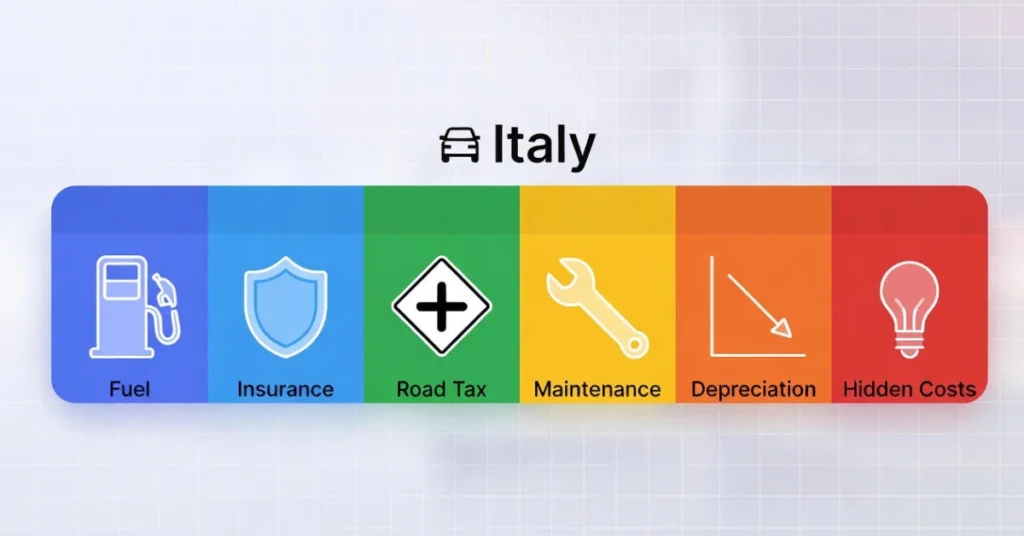
Beyond the obvious expenses, several hidden costs significantly impact your total ownership budget. Parking costs vary dramatically by location, city center garages cost €150-350 monthly, while residential permits range from €20-200 annually depending on your municipality. Highway tolls add another layer of expense, as Italy’s extensive toll system charges €0.07-0.12 per kilometer. A daily 50 km commute adds €1,500-2,500 annually. Depreciation represents perhaps the largest hidden cost: new cars lose 20-25% of their value in the first year (€3,000-8,000 for most vehicles) and 55-65% by year five. This hidden cost often exceeds all other annual expenses combined.
Tax Deductions Most Owners Miss
If you use your vehicle for business, significant deductions are available that can reduce your effective costs substantially. Sales representatives can deduct 80% of all vehicle expenses, while professionals like lawyers and doctors deduct 20% for one vehicle. Deductible expenses include the purchase price or lease payments, all fuel costs, insurance premiums, road tax, maintenance, tires, tolls, parking fees, and even car loan interest. A sales representative spending €5,000 annually on their car can deduct €4,000, saving €920 in taxes at a 23% rate.
Electric Vehicle Incentives Make EVs Competitive
Italy actively encourages electric vehicle adoption through generous financial incentives. Italy’s 2025 Ecobonus provides up to €11,000 for new electric vehicles when trading in an old car, or €7,500 without trade-in. Plug-in hybrids receive up to €8,000 with trade-in. Beyond purchase incentives, EVs enjoy a five-year bollo exemption (saving €150-400 annually), 10-30% insurance discounts, free street parking in many cities, and free ZTL entry. For company cars, EVs receive exceptionally favorable tax treatment; employees are taxed on just 25% of the vehicle’s value versus 50% for combustion engines.
Regional Comparison
Geographic location creates dramatic cost variations across Italy that can mean thousands of euros in annual differences. Bologna residents with a small gasoline car pay around €4,000-5,500 annually, while Naples residents with similar vehicles face €5,500-7,500 due to insurance costs alone. The most affordable regions are Friuli-Venezia Giulia (€3,500-5,000 annually), Veneto (€4,000-5,500), and Emilia-Romagna (€4,200-5,800). The most expensive are Lombardy, Lazio, and Campania, all of which range from €5,000-7,500 annually.
| Region | Average Annual Cost (Small Gasoline Car) |
|---|---|
| Friuli-Venezia Giulia | €3,500-5,000 |
| Veneto | €4,000-5,500 |
| Emilia-Romagna | €4,200-5,800 |
| Bologna | €4,000-5,500 |
| Lombardy | €5,000-7,500 |
| Lazio | €5,000-7,500 |
| Campania | €5,500-7,500 |
What Actually Costs
Examining a complete ownership scenario reveals how these costs combine in practice. Consider a professional in Milan driving a 2021 Volkswagen Golf diesel 20,000 km yearly. Annual costs include €1,700 for fuel, €580 for insurance, €284 for road tax, €450 for maintenance, €800 in tolls, and €1,800 for monthly garage parking, totaling €5,834 before business deductions. With 20% business deductibility and a 35% tax rate, the net cost drops to €5,426 annually. The same person with a 2024 Tesla Model Y as a company car pays just €1,914 annually in running costs, thanks to cheap electricity, insurance discounts, and tax exemptions. With full business deductibility and purchase incentives, the effective annual cost over five years is €5,414, competitive with the diesel despite a much higher purchase price.
Should You Even Own a Car?
Before committing to vehicle ownership, consider whether alternatives might serve your needs better. In major Italian cities with excellent public transport, car ownership isn’t always economical. A monthly garage pass alone costs more than an annual transit pass. Consider alternatives like car sharing (€0.25-0.35 per minute), occasional rentals (€200-500 weekly), or combining public transport with weekend rentals for total annual costs of €1,500-3,000. Car ownership makes sense for families, rural residents, professionals requiring client visits, and those with poor public transport access. But urban singles with occasional driving needs often save thousands annually by skipping ownership entirely.
Would you like to read more about similar subjects? Take a look at our related articles here: leasing a car in Italy, van life in Italy and utility bills in Italy.
Cost of Cars in Italy – Survey
1. What do most people underestimate when considering car ownership costs?
The purchase priceOngoing expenses
Registration paperwork
2. How much does the average Italian household spend annually on car-related expenses?
€1,000–2,000€3,000–6,000
€7,000–9,000
3. How many mandatory costs must every car owner in Italy pay?
TwoThree
Five
4. What determines the amount of Bollo Auto you pay?
Engine size onlyPower and environmental class
Vehicle value
5. Which region has the highest average insurance costs?
Friuli-Venezia GiuliaCampania
Veneto
6. When is the first mandatory vehicle inspection required?
After two yearsAfter four years, then every two years
After five years
7. At what power level does the superbollo tax apply?
Above 150 kWAbove 185 kW
Above 200 kW
8. Which fuel type has the lowest annual cost when charged at night rates?
DieselLPG
Electric
9. What is often the biggest hidden cost of car ownership?
ParkingTolls
Depreciation
10. Which benefit do electric vehicles receive in most regions?
Free chargingFive-year bollo exemption
Free insurance