
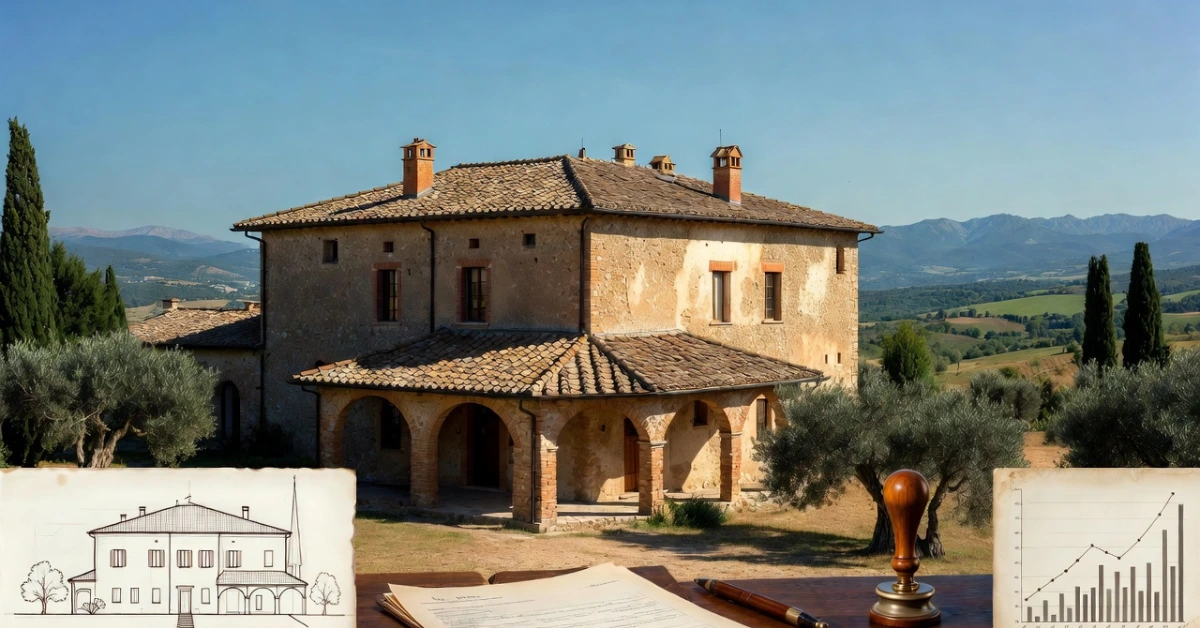
Buying a historic property in Italy differs substantially from buying a modern property. Although your eyes may be dazzled by terracotta tiles, wood beams, frescoes on the ceiling, and stone walls, the legal and financial complexity of a historic property in Italy is much higher.
When you buy a historic property in Italy, you don’t simply buy a house; you adopt a legacy with its own set of constraints for renovation. For instance, there are legal constraints on construction in Italy. The Italian government has put in place legal constraints that require approval from the “Superintendency” (Soprintendenza).
It is worth noting that there are significant differences between tax obligations for purchasing, restoring, and owning a historic home and those of owning a normal home. Thus, it is very important to focus more on compliance, renovation, and overall costs rather than living imagery.
How a Historic Property Sale in Italy Differs from Buying a Modern Home
When purchasing a modern house in Italy, the essential checks to be made are relatively simple. In the case of historic properties, however, the legal position is particularly intricate.
Firstly, it is necessary to assess whether the property is subject to a “vincolo storico” in accordance with Legislative Decree 42/2004 (Codice dei Beni Culturali). If it is, the Ministry of Culture has a pre-emption right (diritto di prelazione), allowing the State to purchase the property at the same conditions and for the same price as the private purchaser, within a specified time frame following the signing of the deed.
Secondly, there are considerable variations in renovation requirements. While it may be possible to retain original features like terracotta tiles, wooden beams, and other features on the façade of the property, renovation of the structure itself must be authorized by the Superintendence (Soprintendenza), responsible for safeguarding cultural heritage. In this respect, unlike modern properties, it will not be possible to make changes to the internal structure of the property, windows, roofs, and so forth.
Thirdly, the process will take longer. In addition to the cost of renovation itself, there will be costs associated with obtaining the necessary permissions from the relevant authorities.
So, the process of purchasing a historic property in Italy is not simply a private law transaction. Rather, it is a highly complex interaction between private law, urban planning law, and cultural heritage law. You will not simply be buying a property; you will be entering a highly intricate legal system.
Due Diligence: Legal Checks Before You Buy
In the case of purchasing historical buildings in Italy, normal checks are not necessary. It is important to assess cultural protection status, structural soundness, tax risks, and compliance before entering the preliminary agreement.
Cultural Heritage Restrictions (Vincolo Storico)
The initial step is to verify whether the property is subject to Cultural Heritage Restrictions as per Legislative Decree 42/2004 (Codice dei Beni Culturali). In this case, different restrictions will be involved, including:
- Structural changes
- Facade changes
- Roofing materials
- Windows and finishes
- Internal features of historical interest
Furthermore, the Ministry of Culture will also have a right of pre-emption (diritto di prelazione). After signing the deed of sale, the state will have a limited period of time during which it will be able to intervene and purchase the property on the same conditions as before. This is a legal risk that does not occur when purchasing a modern house.
Urban Planning and Cadastral Compliance
Historic properties often underwent modifications decades ago. Internal walls, room divisions, terraces, or annexes may not match official records.
Before closing, you must verify:
- Urban planning compliance (conformità urbanistica)
- Cadastral alignment (conformità catastale)
- Existence of building permits for past renovations
If there is any issue, you might need to put it right before you conclude the purchase. Otherwise, it might become hard when you want to sell, finance, or even plan for renovation works.
Structural and Technical Condition
The charm of original terracotta tiles, wooden beams, stone walls, and vaulted ceilings is undeniable, yet it also hides potential structural issues. To discover them, it is advisable to request a technical inspection of the property, including its foundation, roof condition, humidity and rising dampness, seismic resistance, and status of electrical and plumbing systems. In addition, restoration costs of historical properties are often much higher than initial estimates. Therefore, it is highly advisable that a structural inspection be carried out before agreeing on a final price.
Energy Compliance and Modern Standards
Another factor to be considered is that many historical houses are not energy compliant and fail to meet current regulations on energy efficiency. However, heritage constraints often prohibit changes to insulation, window replacements, and changes to façade design. This is a dilemma because it is impossible to improve energy efficiency without making changes that are not allowed by heritage regulations.
Before making a purchase, it is recommended to calculate restoration costs and assess potential savings on energy bills, the need for a new heating system, tax deductions on renovation works, and potential recovery of VAT on restoration works. Otherwise, your final expenditure could be much higher than your purchase price.
Renovation Permits and Superintendency Approval Process
When buying historic properties in Italy, it is important to note that the renovation process begins with approval, not construction.
In cases where the property comes under the Italian Legislative Decree 42/2004, which includes properties with a “vincolo storico,” approval must be obtained before undertaking any work on the property by the Superintendency (Soprintendenza).
This includes not only major renovations to the property but also work on the facade, roof, and windows, as well as interior work that affects aspects of historical interest.
In other words, even if you intend to preserve original terracotta floors, wooden beams, or vaulted ceilings, you cannot assume full freedom to modify layout or materials. The authorities evaluate whether your proposed work respects the architectural integrity of the building.
Approval Timelines and Practical Delays
Authorization does not happen overnight. Depending on the region and the complexity of the property, the approval process may take several months. For architecturally significant homes, the review can become even more detailed.
During this period, you cannot begin protected changes. Contractors remain on hold, financing schedules may shift, and project costs may increase. For this reason, renovation planning must include administrative timing, not only construction duration.
Restoration Budgeting and Hidden Costs
The price tag does not always reveal the real cost involved in the renovation process, especially when it comes to properties that require specialized materials and labor to undertake the work. In cases where the property has original materials such as terracotta tiles, stone facades, and wooden beams, it is important to note that the renovation process must adhere to traditional techniques and standards, which can increase the overall renovation costs.
In addition, there will be the cost of obtaining architectural and engineering reports, energy efficiency upgrades, and Value Added Tax on the renovation work, among other factors that can increase the overall renovation costs.
For this reason, before completing a historic property sale in Italy, you should prepare a realistic restoration budget that includes legal compliance, professional fees, and timing risks, not only visible construction expenses.
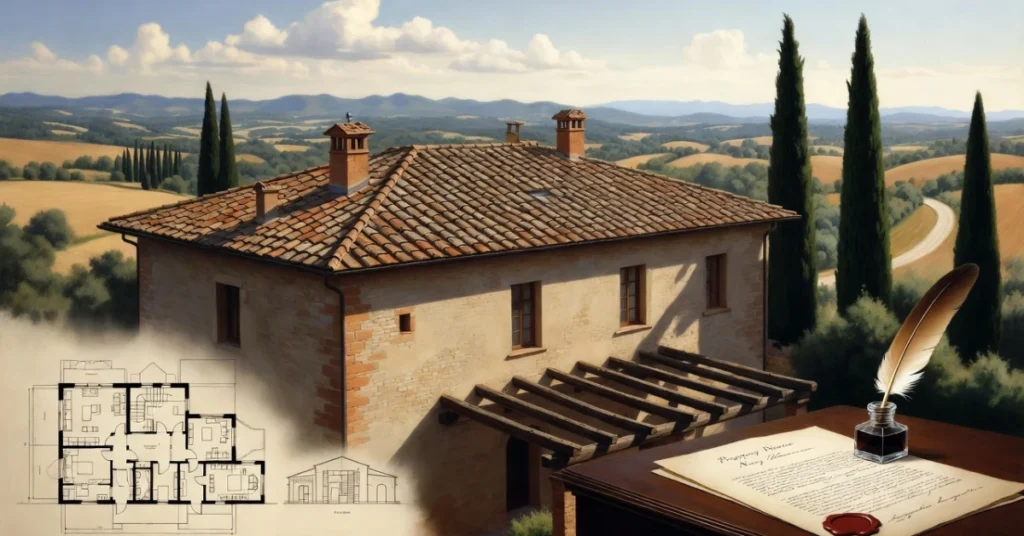
Purchase Taxes, VAT, and Ongoing Ownership Costs
As already discussed, when you buy historic properties in Italy, the purchase price is only one part of the financial equation. Taxes, registration costs, and long-term ownership expenses can significantly affect your total investment.
Registration Tax vs VAT
If you purchase from a private seller, the transaction is generally subject to registration tax instead of VAT. The rate depends on whether the property will be your primary residence or a second home. In most cases, second-home purchases carry a higher registration tax.
If you purchase from a developer or company that renovated the property, VAT may apply instead of registration tax. The VAT rate varies depending on the property classification and the seller’s status. This distinction can materially change your upfront tax exposure.
Historic classification may also affect tax treatment. In certain cases, properties formally recognized as cultural assets can benefit from reduced registration tax rates. However, these benefits often come with ongoing maintenance obligations.
Annual Property Taxes
After completion, you must budget for ongoing property taxes. Italy applies IMU (Imposta Municipale Unica) on second homes and certain high-value properties. While primary residences may benefit from exemptions, historic properties often fall into higher cadastral categories, which can increase annual tax exposure.
In addition, you may face local service taxes and condominium fees if the property forms part of a larger historic building.
Historic buildings also tend to carry higher maintenance costs. Preservation of façades, roofs, and original materials requires periodic investment. Unlike modern homes, deferred maintenance can lead to structural deterioration and regulatory issues.
Renovation VAT and Tax Incentives
Restoration works may qualify for reduced VAT rates in specific situations. Italy has also introduced renovation tax deductions over the years to encourage building improvement and energy upgrades.
However, eligibility depends on property type, ownership structure, and compliance with technical requirements. Heritage restrictions may limit access to certain energy-efficiency incentives if modifications alter protected elements.
Before committing to renovation, you should verify whether tax deductions apply and whether they align with your long-term ownership strategy.
Buying as an Individual or Through a Company
When you decide to buy historic properties in Italy, the ownership structure becomes a strategic decision. You can purchase as a private individual or through a company. Each option carries legal, tax, and succession consequences.
Buying as an Individual
If you purchase personally, the transaction is usually simpler. Registration tax or VAT applies directly, and ongoing property taxes remain under your name.
However, personal ownership means the property becomes part of your private estate. This has implications for inheritance planning, especially if you are not resident in Italy. Italian succession rules include forced heirship provisions under the Civil Code. Certain heirs, such as children and spouses, have legally protected shares of the estate.
If you hold international assets, cross-border succession coordination becomes important. Although EU Regulation 650/2012 allows some choice of applicable law, the interaction between jurisdictions must be carefully reviewed.
Personal ownership is often suitable for lifestyle use. However, if you intend to generate rental income or operate a hospitality activity, additional considerations arise.
Buying Through a Company
Some buyers choose to structure the acquisition through an Italian or foreign company. This can offer flexibility in certain scenarios, particularly when the property serves as an investment or income-generating asset.
However, corporate ownership introduces different tax treatment. Rental income becomes corporate income. Sale gains may be taxed differently. In addition, annual corporate compliance obligations increase administrative costs.
If the company is foreign, Italian authorities may still impose reporting requirements. Furthermore, transferring shares of the company does not always avoid Italian taxation or inheritance exposure, depending on the structure and residency.
Before deciding, you should compare acquisition taxes, ongoing taxation, and long-term exit strategy.
Long-Term Investment Potential and Resale Considerations
Historic properties in Italy can offer strong long-term value, but only if you approach them as structured investments rather than emotional purchases.
Unlike modern apartments, historic homes derive value from scarcity, architectural integrity, and location. Properties with preserved original terracotta floors, exposed wooden beams, stone façades, and documented historical relevance often maintain strong demand in premium regions such as Tuscany, Umbria, Lake Como, and certain areas of Rome. However, long-term appreciation depends on compliance and maintenance.
Rental Income and Tourism Use
If you intend to generate income, you must review local regulations carefully. Short-term rentals, agriturismo operations, and hospitality use often require municipal authorization and tax registration.
In some cases, heritage restrictions limit structural modifications needed for hospitality conversion. For example, adding bathrooms, installing modern systems, or altering internal layout may require approval from the Superintendency.
Furthermore, rental income becomes taxable in Italy. The applicable regime depends on whether you own the property personally or through a company. Therefore, income planning must be integrated into your acquisition structure from the beginning.
Resale Limitations
When you buy historic properties in Italy, resale freedom may differ from modern homes.
If the property is subject to a vincolo storico, the State may again retain the right of pre-emption in future transfers. This can slow down resale transactions and introduce uncertainty for buyers.
Additionally, heavy restoration costs do not always translate into equivalent resale premiums. Buyers often value preserved authenticity, but they may discount over-personalized renovations.
Liquidity can also vary. High-value historic estates attract a narrower buyer pool compared to standard residential properties. Therefore, exit timelines may be longer.
Cross-Border Ownership and Inheritance Implications
Foreign buyers must also consider international tax and inheritance planning.
If you hold the property personally, it may fall within Italian inheritance tax rules depending on residency and asset location. If you hold it through a foreign entity, additional reporting obligations may arise.
Currency exposure and cross-border taxation must also be evaluated. For non-EU buyers, long-term residency plans may further affect tax exposure.
What to Know Before Purchasing Historic Real Estate in Italy
Buying a historic home in Italy is not simply a real estate transaction. It is an entry into a regulated legal and financial framework that continues long after completion.
Unlike other property deals, there is cultural heritage legislation, renovation constraints, and tax risks that will affect the property in the long term. While the beauty of original terracotta tiles, wood beams, paintings, and century-old facades is undeniable, some constraints go with them.
Before you sign the preliminary contract, it is important to determine what you want to achieve with the property. Is it to be a home, a long-term investment, a tourism investment, or a cross-border estate plan? Each of these will require different structures and tax strategies.
Buying and owning a historic property can be a good investment because it will retain its value and increase in the long term in the right locations. With the correct structures in place, buying and owning a historic property in Italy can be a mix of architectural heritage and diversification of assets. However, using looks alone to make a decision will ultimately expose you to risks that were not apparent at first glance.
Would you like to read more about similar subjects? Take a look at our related articles here: write a will in Italy, Prefab home Italy and home renovation incentives in Italy.
Buying Historic Properties in Italy – Quick Check
1. Who must approve renovation works for properties under heritage protection?
MunicipalitySuperintendency (Soprintendenza)
Private Notary
2. What right does the State have if a property is subject to “vincolo storico”?
Right to increase taxesRight of pre-emption
Right to cancel the sale
3. What compliance must be verified before closing?
Urban and cadastral complianceOnly energy certificate
Only building age
4. Why is a structural inspection recommended?
To decorate the propertyTo identify hidden structural and technical issues
To reduce purchase price automatically
5. Can renovations start before approval?
Yes, alwaysNo, approval is required first
Only for minor changes
6. What tax may apply when buying from a private seller?
Corporate taxRegistration tax
Payroll tax
7. What affects inheritance planning when buying personally?
Forced heirship rulesRental contracts only
Energy efficiency laws
8. Why can resale of historic properties take longer?
No demand existsState pre-emption and limited buyer pool
Automatic government purchase
9. What limits energy upgrades in protected properties?
Unlimited upgradesHeritage restrictions
No regulations
10. What is essential before deciding on ownership structure?
Choose randomlyCompare tax, compliance, and long-term strategy
Only consider purchase price